

March 17, 2026ProgramGuardians for the Voiceless: Justice Minallah Reflects on Judging the Rights of Animals and Nature in Pakistan
At Harvard Law School, Pakistani jurist Athar Minallah discussed the pioneering role of Pakistani courts in recognizing the legal rights of non-humans and articulating the corresponding constitutional and moral obligations humans owe to animals, ecosystems, and nature.
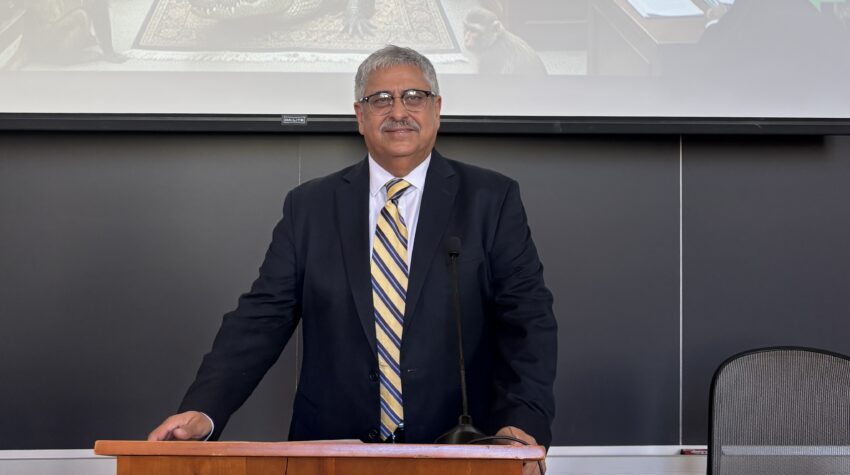
Earlier this month, our Program welcomed Pakistani jurist Athar Minallah — former judge of the Supreme Court of Pakistan and former Chief Justice of the Islamabad High Court — to Harvard Law School, where he delivered a lecture on the pioneering role of Pakistani courts in recognizing the legal rights of non-humans. Reflecting on his tenure as Chief Justice of the Islamabad High Court, Justice Minallah described how encounters with marginalized humans gradually gave way to deeper questions: does law only hear the human voice, or can it recognize the silent pulse of life beyond our own species?
Grounded in the principle that life itself possesses intrinsic value — a conviction shaped by Islamic legal philosophy and comparative constitutional study — his court became the first jurisdiction to declare non-human beings as legal persons, ordering the relocation of 878 animals from Islamabad’s Marghazar Zoo to species-appropriate sanctuaries. The case of Kaavan the elephant, subjected to decades of solitary captivity, became emblematic of this shift: a living symbol of what it means to extend constitutional protection to the voiceless.
Beyond animal rights, Justice Minallah described the extension of this reasoning to ecosystems, flora, fauna, and natural spaces, where his court held powerful actors accountable for environmental harm. By declaring forests, waterways, and ecosystems as rights-holders, the court transformed climate justice from rhetoric into enforceable law. This was not judicial activism, Justice Minallah emphasized, but rather a constitutional and moral imperative: humanity, endowed with rationality and foresight, bears a duty of stewardship toward the natural world. The gravest burden of ecological destruction, he argued, falls on those with no voice to resist it — and it is precisely there that courts must act as guardians.